
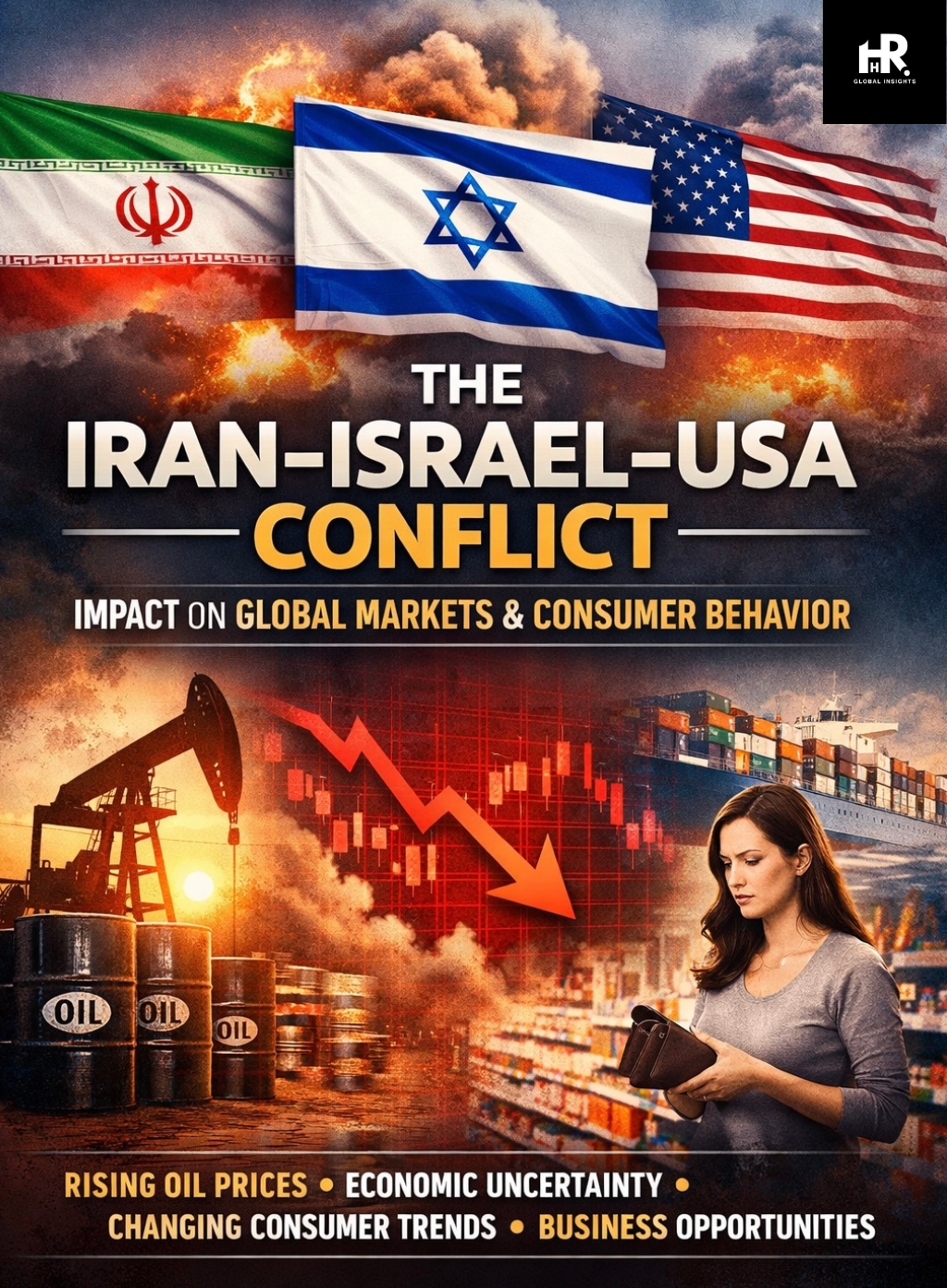
The ongoing geopolitical tensions between Iran, Israel, and the United States have evolved into a major global event with far-reaching economic implications. What initially appeared to be a regional conflict is now influencing global trade, energy markets, investor sentiment, and consumer behavior across continents. In today’s interconnected world, such conflicts do not remain isolated—they ripple through supply chains, financial markets, and everyday consumer decisions. This blog by Hyper Hive Global Insights explores the broader market research perspective, analyzing both the positive and negative impacts on businesses and consumers worldwide.
One of the most immediate and visible impacts of the conflict is on global energy markets. The Middle East plays a critical role in oil production and supply, and any disruption in this region leads to price volatility. Rising oil prices have a cascading effect—transportation becomes expensive, manufacturing costs increase, and inflationary pressures build up globally. Alongside this, stock markets have become increasingly sensitive to geopolitical news, resulting in volatility and uncertainty for investors and businesses alike.
At the macro level, economies are facing a dual challenge: controlling inflation while maintaining growth. This delicate balance is making policymaking more complex and creating an uncertain environment for long-term planning.
The ongoing conflict is creating multiple challenges for businesses across industries. Rising fuel prices are significantly increasing logistics and operational costs, especially for companies dependent on global supply chains. Import-export disruptions are becoming more frequent, leading to delays and higher costs of raw materials. Additionally, investor confidence tends to decline during geopolitical instability, which results in slower funding cycles, especially for startups and emerging businesses.
Companies are also facing demand-side pressure as consumers cut back on non-essential spending due to inflation. This directly impacts sectors such as retail, travel, luxury goods, and entertainment. Moreover, currency fluctuations and trade uncertainties are making international expansion riskier than before.
• Increased operational and transportation costs
• Supply chain disruptions and delays
• Reduced consumer demand in non-essential categories
• Slower investments and funding challenges
• Higher financial and geopolitical risks
Despite the challenges, certain sectors and business models are expected to benefit from this situation. Energy companies, especially those involved in oil, gas, and renewable energy, are likely to see increased demand and investment. Similarly, local manufacturing and domestic supply chains are gaining importance as businesses try to reduce dependency on imports.
Defense, cybersecurity, and technology sectors are also witnessing growth due to increased global focus on security and resilience. Additionally, businesses that can quickly adapt their pricing strategies, optimize costs, and align with changing consumer needs have the opportunity to strengthen their market position.
• Growth in energy and renewable sectors
• Rise of local manufacturing and self-reliance
• Increased demand in defense and tech industries
• Opportunities for cost optimization and innovation
• Stronger positioning for agile and adaptive businesses
From a consumer standpoint, the most noticeable effect is rising inflation. As fuel prices increase, the cost of goods and services also rises, making everyday life more expensive. Consumers across the globe are experiencing reduced purchasing power, forcing them to rethink spending habits.
Travel and lifestyle expenses are also becoming costlier, leading to a decline in discretionary spending. In many regions, food prices are rising due to supply chain disruptions and increased agricultural costs, adding further pressure on household budgets. This environment creates uncertainty and cautious financial behavior among consumers.
• Higher cost of living and inflation
• Reduced disposable income
• Decline in luxury and non-essential spending
• Expensive travel and lifestyle costs
• Increased financial uncertainty
While the situation is challenging, it is also driving certain positive behavioral changes among consumers. There is a growing awareness around budgeting, saving, and financial planning. Consumers are becoming more value-conscious and making more informed purchasing decisions.
Additionally, there is a noticeable shift toward local products and sustainable consumption, as people seek affordability and reliability. Digital adoption is also accelerating, with consumers exploring online platforms for better deals and convenience.
• Increased financial awareness and savings mindset
• Smarter, value-driven purchasing decisions
• Growth in demand for local and affordable products
• Shift toward sustainable consumption
• Higher adoption of digital and online platforms
From a market research perspective, this conflict highlights how deeply interconnected geopolitics and consumer markets have become. Businesses can no longer rely solely on historical data; real-time geopolitical analysis is now essential for decision-making.
The situation is also accelerating long-term global trends such as energy transition, supply chain diversification, and regional economic shifts. Companies that invest in understanding these patterns will be better equipped to navigate uncertainty and capitalize on emerging opportunities.
Looking ahead, the global market trajectory will depend heavily on how the conflict evolves. A resolution or de-escalation could stabilize markets and restore growth momentum. However, prolonged tensions may keep inflation high and slow down economic recovery. In the worst-case scenario, further escalation could lead to a broader global economic slowdown or even recession.
Regardless of the outcome, one thing is clear—businesses and consumers alike are entering a new phase of uncertainty where adaptability, resilience, and data-driven decision-making will define success.
The Iran–Israel–USA conflict is not just a geopolitical issue—it is a defining factor for the global economy and consumer behavior. While it presents significant challenges in terms of cost pressures, inflation, and uncertainty, it also opens doors for innovation, strategic shifts, and new opportunities.
At Hyper Hive Global Insights, we believe that understanding these evolving dynamics is crucial for businesses to stay competitive. By turning uncertainty into actionable insights, organizations can not only survive but thrive in an ever-changing global landscape.